
Local SEO Explained: How Australian Small Businesses Get Found on Google, Google Maps and AI
You're great at what you do. Your customers appreciate your work, recommend you to friends and often come back. Yet when someone nearby searches for the services you offer, your business is difficult to find.
If you've ever wondered why a competitor appears at the top of Google while your business seems almost invisible, you're not alone; it's one of the most common frustrations I hear from small business owners.
Many business owners work hard to stay active on Facebook and Instagram, posting regularly in the hope that potential customers will see their content. Others question whether having a website is even relevant anymore, particularly as social media and AI continue to reshape how people discover businesses online.
The truth is that social media, your website and Local SEO each play a different role in your marketing.
Social media is excellent for building relationships with existing customers, sharing your personality and staying connected with your community. However, its reach is largely controlled by platform algorithms. Unless someone already follows your business or your content is widely shared, many potential customers may never see your posts.
Search works differently. When someone opens Google Search, browses Google Maps or asks an AI assistant for recommendations, they're actively looking for a solution. They already have a need. Your goal is to make it easy for them to discover your business at that exact moment.
Throughout this guide, we'll primarily refer to Google because it's where most Australians search today. However, the same principles also help strengthen your visibility on Bing and other search platforms, preparing your business for AI-powered search experiences.
Those searches might sound like this:
• "Can you recommend a massage therapist near Ballina?"
• "Who's a reliable electrician in Byron Bay?"
• "What's a good café in Lennox Head with outdoor seating?"
• "Find a landscaper in the Northern Rivers who specialises in native gardens."
• "Recommend an accountant for a small business near me."
Those questions may be typed into Google Search, spoken into a mobile phone, searched through Google Maps or asked directly to AI tools such as ChatGPT or Gemini.
Although the way people search continues to evolve, one thing hasn't changed. People are still looking for trustworthy local businesses that can solve a problem. Helping the right people find your business at exactly the moment they're looking for your services is what Local SEO is all about.
Your website also remains one of your most valuable business assets. Unlike social media, where content quickly disappears down a newsfeed, your website is the one online space you own and control. It showcases your expertise, answers your customers' questions and provides Google, Bing and AI assistants with the information they need to understand and confidently recommend your business.
Thankfully, you don't need to become an SEO expert or completely rebuild your website to improve your visibility. A series of thoughtful, manageable improvements can make a significant difference over time.
Whether you're a wellness practitioner in Ballina, an electrician in Byron Bay, a café owner in Lennox Head, a landscaper servicing the Northern Rivers or a local accountant supporting small businesses, the principles remain the same.
This guide will help you understand how modern search works and show you practical ways to position your business so it's easier to find, easier to trust and ultimately easier to choose.
In This Article
What Local SEO is and why it matters.
Why Local SEO still matters in the age of social media and AI.
How people search using Google Search, Google Maps and AI.
How Google decides which businesses appear in local search results.
Why your Google Business Profile is one of your most valuable marketing assets.
The role your website plays in building trust and visibility.
How AI is changing the future of search.
What Generative Engine Optimisation (GEO) means for small businesses.
Practical improvements you can make today to strengthen your online presence.
Why Local SEO Still Matters in the Age of Social Media and AI
With so much attention focused on social media and artificial intelligence, it's understandable that some business owners wonder whether Local SEO is still relevant. The answer is an emphatic yes.
Social media is designed to help people discover and engage with content while they're browsing. Local SEO serves a different purpose. It helps your business appear when someone is actively searching for the products or services you offer.
Your website also remains your digital home. Unlike social media platforms, where algorithms and features can change overnight, your website is the one place online where you have complete control over your content, messaging and customer experience.
Search platforms such as Google and Bing, along with AI assistants like ChatGPT and Gemini tools all rely on clear, consistent information to understand your business. They look for signals across your website, your Google Business Profile, online reviews and other trusted sources before deciding whether to recommend your business.
Rather than replacing Local SEO, AI is making strong Local SEO even more important. Businesses with accurate information, helpful content and a trustworthy online presence are better positioned to be discovered wherever people choose to search.
How People Search Today
The way people search has changed significantly over the past few years. Instead of typing a few keywords into Google, many people now ask complete questions through Google Search, Google Maps, voice search and AI assistants such as ChatGPT and Google Gemini.
Whether someone types "electrician Byron Bay" or asks "Who is the best electrician in Byron Bay for an older home?", their goal is exactly the same. They're looking for a trustworthy local business that can solve their problem.
Examples of searches include:
• "Who is the best electrician in Byron Bay for an older home?"
• "Can you recommend a family-friendly café in Lennox Head with good coffee?"
• "Find a massage therapist near Ballina who offers remedial massage."
Your online presence needs to answer three simple questions clearly:
• What do you do?
• Where do you do it?
• Why should someone choose you?
When your website, Google Business Profile, reviews, and other online information consistently communicate those answers, search platforms are far better equipped to recommend your business to potential customers.
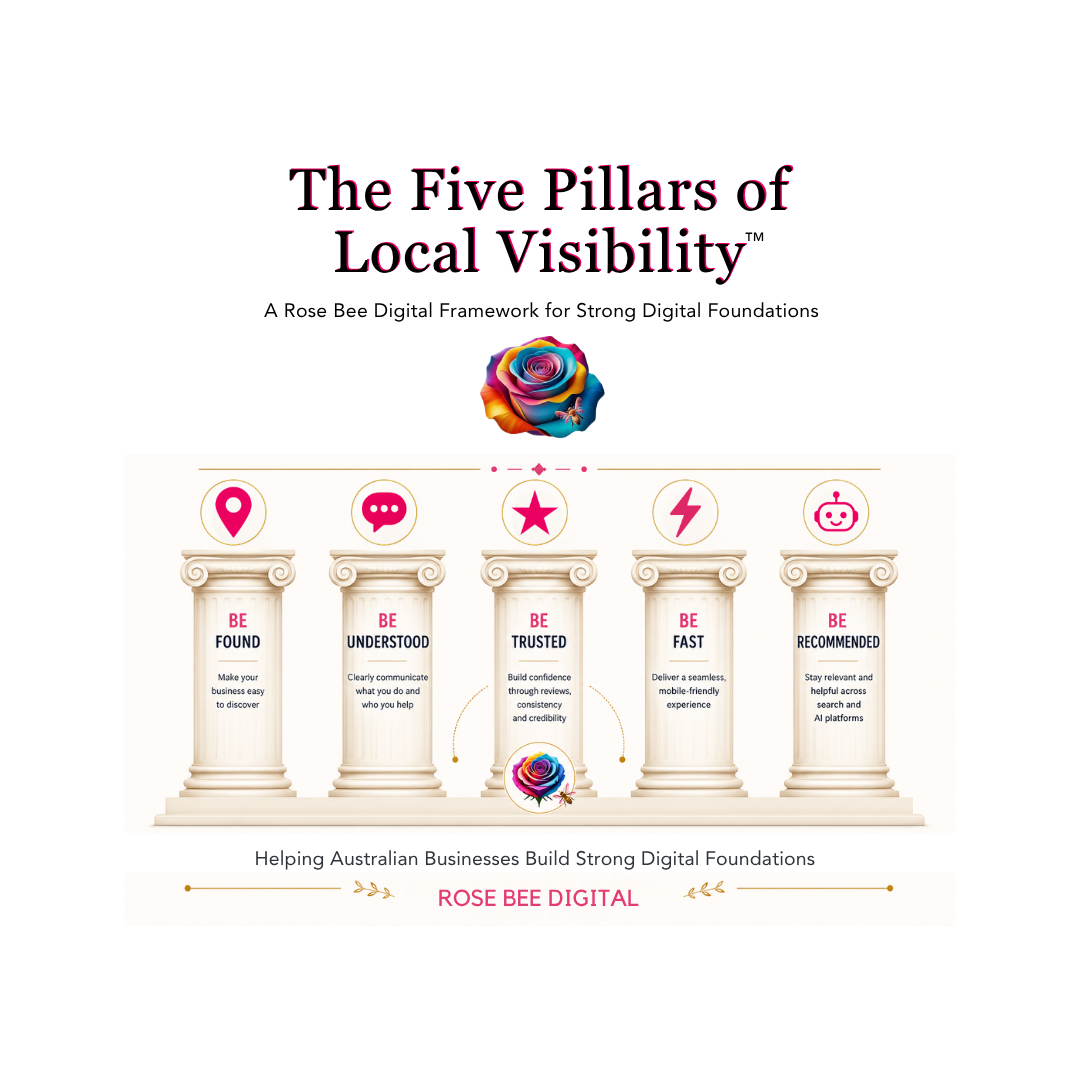
The Five Pillars of Local Visibility
At Rose Bee Digital, we believe that improving your online visibility doesn't come down to a single tactic or platform. It's the result of several interconnected elements working together.
Think of these five pillars as the foundation of your digital presence. Each one supports the others, helping your business become easier to find, understand, trust and recommend. As you read through this guide, we'll explore each pillar in more detail and show you practical ways to strengthen them over time.
The Five Pillars of Local Visibility™ work together to create strong digital foundations. While each pillar is important on its own, the greatest results come when they're implemented as a complete framework.
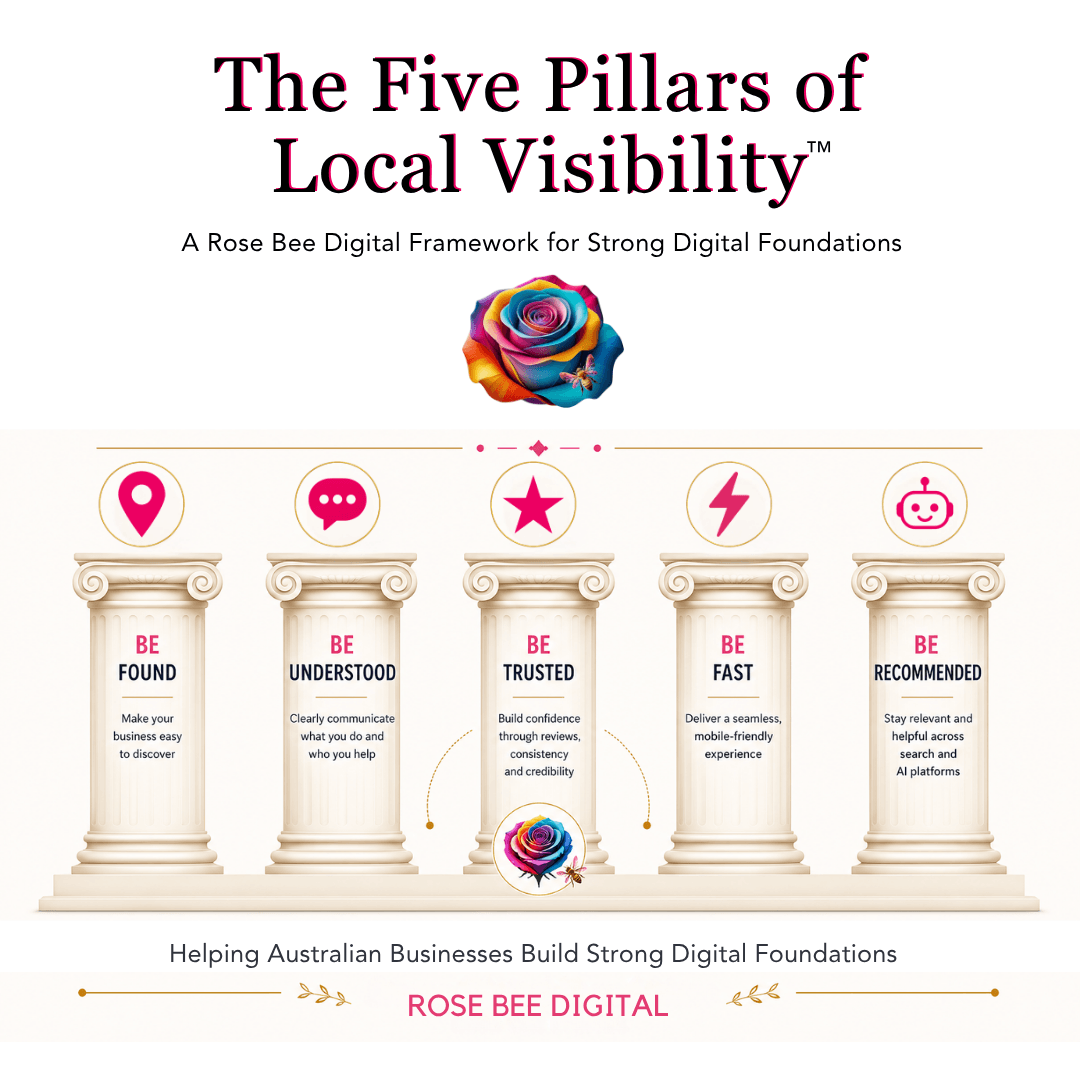
The Five Pillars of Local Visibility™ provide a practical framework for helping customers
and AI-powered search tools discover, understand and trust your business online.
Ready to See How Your Business Scores?
Understanding the Five Pillars of Local Visibility™ is the first step. The next is finding out how your own business performs.
Download the free Local Visibility Scorecard to assess your website against all five pillars in just a few minutes. You'll receive a practical 25-point self-assessment, score interpretation and simple recommendations to help you identify where to focus first.
1. Be Found
Make it easy for customers to discover your business through Google Search, Google Maps, your Google Business Profile, local directories and other trusted platforms.
2. Be Understood
Clearly explain what you do, who you help and where you work using simple language that both people and search engines can understand.
3. Be Trusted
Build confidence through consistent business information, authentic customer reviews, helpful content and genuine expertise.
4. Be Fast
Deliver a fast, mobile-friendly and accessible website that provides an excellent experience for every visitor.
5. Be Recommended
Create content and business information that is structured clearly enough for search platforms such as Google and Bing, and for AI assistants like ChatGPT and Gemini tools, so they can confidently recommend your business when people ask for local services.
Together, these five pillars form the foundation of a strong local visibility strategy. Throughout the rest of this guide, we'll explore each one in more detail and show you practical ways to strengthen your online visibility, build trust and attract more of the right customers.
Pillar 1: Be Found
Everything starts here. If potential customers can't find your business, they can't learn about your services, read your reviews or contact you. Before you can earn trust or generate enquiries, your business first needs to be visible where people are searching. For many Australian small businesses, that means appearing in Google Search, Google Maps and increasingly, AI-powered search tools.
The good news is that Google isn't looking for the biggest businesses. It's looking for the businesses that are most relevant to the person searching. Understanding how Google decides which businesses to show is one of the most valuable things you can learn about Local SEO.
What Is Local SEO?
Despite the technical name, Local SEO is actually quite straightforward.
Local SEO (Local Search Engine Optimisation) is the process of improving your online presence so your business is more likely to appear when people search for products or services in your area.
Unlike traditional SEO, which often focuses on reaching a broad national or international audience, Local SEO is about connecting with people nearby who are ready to take action.
Imagine someone searches for:
• "remedial massage Ballina"
• "electrician Byron Bay"
• "best café Lennox Head"
• "accountant near me"
Google's job is to recommend businesses that are most likely to meet that person's needs. Local SEO helps your business become one of those recommendations.
Importantly, Local SEO isn't about trying to trick Google into ranking your business. It's about making it easy for Google to understand exactly who you are, what you do, where you operate and why customers trust you.
The easier you make that job, the more confidence Google has in showing your business to potential customers.
How Google Decides Which Local Businesses to Show
One of the biggest myths about Local SEO is that there's a secret formula for reaching the top of Google - there isn't.
Google uses hundreds of signals to determine which businesses appear in search results, and while no one outside Google knows the exact algorithm, Google has been very open about the three core factors that influence local rankings.
1. Relevance
Relevance is about how closely your business matches what someone is searching for.
If a person searches for "family accountant Ballina", Google will look for businesses that clearly explain they provide accounting services and are located in or serve Ballina.
This is one reason why having clear service pages, accurate business categories and detailed business descriptions is so important. The more clearly you explain your services, the easier it is for Google to connect your business with relevant searches.
2. Distance
Distance refers to how close your business is to the person searching, or to the location they've specified in their search. Someone searching from Lennox Head may see different results than someone searching from Byron Bay, even if they use the same search terms. While you can't change your physical location, you can clearly communicate the suburbs and regions you service throughout your website and Google Business Profile. For businesses that travel to clients, such as electricians, landscapers or mobile therapists, accurately defining your service area is particularly important.
3. Prominence
Prominence is Google's way of measuring how established and trustworthy your business appears online.
Google looks at signals such as:
• customer reviews
• review quality and frequency
• links from reputable websites
• mentions across trusted directories
• consistent business information
• website quality
• overall online reputation
This doesn't necessarily mean the oldest business wins. A newer business with an informative website, excellent reviews, and consistent business information can often outperform a larger competitor with an outdated online presence.
Google Business Profile: Your Digital Shopfront
If your website is your digital home, your Google Business Profile is your digital shopfront.
For many businesses, it's the first thing potential customers see before they ever visit your website.
When someone searches for your business by name or looks for services nearby, your Google Business Profile may display:
• your business name
• opening hours
• phone number
• website link
• directions
• customer reviews
• photos
• services
• frequently asked questions
In many cases, a customer decides whether to contact your business without ever visiting your website. That's why keeping your profile accurate, complete and regularly updated is one of the highest-impact Local SEO activities you can undertake.
Some simple ways to improve your profile include:
• selecting the most appropriate business categories
• adding high-quality, recent photographs
• keeping your opening hours current, including public holidays
• responding thoughtfully to customer reviews
• reviewing your services and business description regularly
These small updates send strong signals that your business is active, engaged and committed to providing accurate information.
You've now built the first pillar of local visibility.
Why Google Maps Matters More Than Ever
Many business owners think of Google Maps as nothing more than a navigation tool. In reality, it's one of Australia's most powerful local search platforms.
Every day, people use Google Maps to find cafés, tradies, health practitioners, accountants and countless other local businesses. Increasingly, customers expect to be able to search, compare reviews, browse photos and contact a business without leaving the Maps app.
Appearing prominently in Google Maps isn't separate from Local SEO. It's one of its most valuable outcomes. That's why optimising your Google Business Profile, collecting genuine customer reviews and maintaining accurate business information all contribute to improving your visibility on Google Maps and Google Search.
Throughout this guide, you'll notice that many of the recommendations support both platforms simultaneously. That's because Google Search and Google Maps work together far more closely than many people realise.
Don't Forget Bing
While Google remains the dominant search engine in Australia, it's worth setting up and maintaining your Bing Places profile as well. Much of the information can be imported from your Google Business Profile, making the task relatively quick. As Microsoft's AI-powered search continues to evolve, having an accurate Bing presence may provide additional opportunities for customers to discover your business.
Pillar 2: Be Understood
Once people can find you, they need to understand why you're the right choice. The next challenge is helping both people and search platforms understand exactly what you do. This is where your website becomes invaluable.
While your Google Business Profile provides a snapshot of your business, your website tells the full story. It explains your services, demonstrates your expertise and answers the questions potential customers are already asking.
Think of your website as your digital salesperson. It's available 24 hours a day, helping visitors decide whether your business is the right fit for their needs.
Your Website Is More Than an Online Brochure
One of the biggest misconceptions about websites is that they simply need to "look nice."
Good design is important, but a beautiful website that doesn't answer customer questions or encourage people to take action is unlikely to generate enquiries.
An effective website should help visitors quickly understand:
• what you do
• who you help
• where you work
• how you can help solve their problem
• what to do next
If someone lands on your website and still has to decide whether you offer the service they're looking for, there's a good chance they'll leave and keep searching elsewhere.
Clarity almost always outperforms cleverness.
Write for Your Customers First
When creating website content, imagine you're answering questions during a conversation rather than writing for a search engine.
For example, if you're a massage therapist in Ballina, your website could explain:
the types of massage you offer
who they're suitable for
what happens during a first appointment
how clients can book
where you're located
A Byron Bay electrician might explain:
the residential and commercial work they undertake
emergency call-out availability
the areas they service
common electrical issues they solve
The clearer your explanations, the easier it becomes for both visitors and search platforms to understand your business.
Rose Bee Digital Insight
One of the simplest ways to improve your website is to write down the five questions customers ask you most often. If those questions aren't answered clearly on your website, they should be.
Service Pages Matter
Many small business websites list all of their services on a single page.
While this can work for some businesses, creating dedicated pages for your key services often provides a much better experience for both visitors and search engines.
For example, a Northern Rivers landscaper might create separate pages for:
Landscape Design
Garden Construction
Retaining Walls
Irrigation
Garden Maintenance
Each page allows you to explain the service in greater detail, showcase examples of your work and answer questions specific to that service.
Rather than trying to rank one page for everything, you're creating multiple opportunities for people to discover your business.
Local Content Builds Relevance
One of the easiest ways to strengthen your local visibility is to naturally reference the communities you serve. Rather than repeatedly listing locations, explain how your experience relates to those areas.
For example, a café in Lennox Head might mention its locally sourced produce, its proximity to the beach, or its popularity with weekend visitors.
A local accountant could explain their experience supporting small businesses across the Northern Rivers (or your local area) and the unique challenges regional business owners face.
These details help create genuine local relevance without sounding forced.
Pillar 3: Be Trusted
Being found is only part of the journey. Understanding creates interest. Trust creates enquiries. People also need confidence that they're choosing the right business. Trust has always influenced buying decisions, but it's becoming increasingly important in the digital world.
Google, Google Maps and AI systems all look for signals that indicate a business is credible, established and provides a positive customer experience. Fortunately, many of those same signals also help reassure potential customers.
Reviews Are More Than Five Stars
Customer reviews do much more than improve your average rating. They tell the story of your business through your customers' voices.
Prospective clients often read reviews before visiting a website or contacting a business. They want to know what it's like to work with you, how you communicate and whether others would recommend your services.
Encouraging genuine reviews after a positive experience is one of the simplest and most effective ways to strengthen your online reputation. Rather than focusing on collecting as many reviews as possible, aim for a steady stream of authentic feedback over time.
Responding thoughtfully to both positive and negative reviews also demonstrates that you value your customers and are actively engaged with your business.
Consistency Creates Confidence
Trust is also built through consistency.
Your business name, phone number, email address and service information should be consistent across your website, Google Business Profile and any reputable online directories.
Likewise, your branding, tone of voice and messaging should feel familiar wherever someone encounters your business online. Consistency makes your business easier for people to recognise and easier for search platforms to understand.
Pillar 4: Be Fast
Once someone has found your business and decided they trust you, your website needs to provide a smooth, enjoyable experience.
Visitors expect pages to load quickly, navigation to feel intuitive and information to be easy to find. If a website is slow or difficult to use, many people will leave before taking the next step.
Fortunately, improving website performance doesn't always require a complete redesign. Small improvements often have the greatest impact.
Consider whether your website:
• loads quickly on a mobile connection
• uses appropriately sized, optimised images
• has clear navigation
• uses readable fonts and sufficient colour contrast
• makes it easy to contact your business
• includes clear calls to action
Together, these improvements create a better experience for visitors while also supporting your long-term online visibility.
Accessibility Benefits Everyone
Accessibility is about making your website easier for everyone to use. Simple improvements such as descriptive headings, meaningful button labels, readable font sizes and sufficient colour contrast help visitors navigate your website with confidence. They also make your content easier for search platforms and AI systems to interpret.
Rose Bee Digital Insight
Open your website on your mobile phone and ask someone unfamiliar with your business to find your phone number or booking page. If it takes more than a few seconds, there's probably an opportunity to simplify the experience.
Pillar 5: Be Recommended
Search is evolving rapidly. Increasingly, people are asking complete questions through AI assistants such as ChatGPT, Google Gemini and Microsoft Copilot rather than relying solely on traditional keyword searches.
For example, instead of searching for "accountant Ballina", someone might ask:
"Can you recommend an accountant near Ballina who works with small family businesses?"
These conversational searches require AI systems to understand your business rather than simply match keywords.
What Is Generative Engine Optimisation?
Generative Engine Optimisation, or GEO, is the practice of presenting your business information in a way that helps AI systems understand and confidently recommend your business. The important thing to remember is that GEO doesn't replace Local SEO. It builds upon it.
Businesses with accurate information, helpful content, authentic reviews and well-structured websites are already creating the foundations that AI systems rely on.
Rather than trying to optimise for every new technology, focus on creating content that:
• answers genuine customer questions
• clearly explains your services
• is well organised
• stays accurate and up to date
The goal isn't to write for AI. The goal is to become the most helpful, trustworthy source of information about your business. That's a strategy that's likely to remain effective regardless of how search technology evolves.
Putting the Five Pillars into Action
Improving your local visibility doesn't need to happen all at once. The most successful businesses make consistent improvements over time, building stronger digital foundations with each update.
Whether you're just getting started or refining an existing website, focusing on one pillar at a time can make the process feel far more manageable.
Your Local Visibility Checklist
Use this checklist as a starting point to assess your own online presence.
Pillar 1: Be Found
☐ Claim and verify your Google Business Profile.
☐ Ensure your business name, address and phone number are consistent across your website and online directories.
☐ Select the most appropriate business categories.
☐ Add recent, high-quality photos of your business, products or services.
☐ Review your opening hours and service areas.
Pillar 2: Be Understood
☐ Clearly explain your services on your website.
☐ Create dedicated pages for your key services where appropriate.
☐ Answer the questions your customers ask most often.
☐ Naturally mention the locations you service.
☐ Make it obvious how visitors can contact you.
Pillar 3: Be Trusted
☐ Ask satisfied customers for genuine Google reviews.
☐ Respond professionally to all reviews.
☐ Keep your website information current.
☐ Showcase testimonials, case studies or examples of your work.
☐ Maintain consistent branding across your digital channels.
Pillar 4: Be Fast
☐ Test your website on a mobile phone.
☐ Optimise large images.
☐ Check that pages load quickly.
☐ Make your navigation simple and intuitive.
☐ Ensure text is easy to read on all devices.
Pillar 5: Be Recommended
☐ Keep your website content accurate and up to date.
☐ Publish helpful content that answers customer questions.
☐ Use clear headings and logical page structure.
☐ Review your website regularly as your business evolves.
☐ Focus on being the most helpful source of information about your services.
Rose Bee Digital Insight
Don't try to complete everything in one weekend. Choose one pillar each month and make two or three meaningful improvements.
By the end of the year, you'll have built a much stronger online presence without feeling overwhelmed.
Frequently Asked Questions
How long does Local SEO take to work?
Local SEO is a long-term investment rather than a quick fix. Some updates, such as improving your Google Business Profile, may have an impact within a few weeks. Building authority through helpful website content, customer reviews and a strong online reputation generally takes several months. The businesses that achieve the best results are usually those that continue to make steady improvements over time.
Do I still need a website if my business is active on social media?
Yes. Social media is an excellent way to build relationships and stay connected with your audience, but your website remains your digital home. It's the one online space you own and control, and it's often the primary source of information that Google, Google Maps and AI systems use to understand your business.
Is Local SEO only important for businesses with a shopfront?
Not at all. Local SEO is just as valuable for businesses that travel to their customers or operate from a home office. Electricians, landscapers, photographers, consultants, accountants and many other service-based businesses can all benefit from improving their local visibility.
Do I need to understand AI to prepare my business for AI search?
No. The best way to prepare for AI search is to build a strong online presence. Businesses with clear websites, accurate business information, authentic customer reviews and helpful content are already laying the foundations for future search technologies.
Should I focus on Google Search, Google Maps or AI?
The answer isn't one or the other. The strongest digital strategy supports all three. Improvements you make to your website, Google Business Profile and online reputation often strengthen your visibility across Google Search, Google Maps and AI-powered search experiences simultaneously.
Final Thoughts
The way people search for local businesses is evolving, but the fundamentals haven't changed.
People still want to find businesses they can trust. They still value expertise, authenticity and positive customer experiences. What has changed is the number of places they search. Today's customers might discover your business through Google Search, Google Maps or an AI assistant, often before they ever visit your website.
Rather than chasing every new marketing trend, focus on building strong digital foundations. A clear website, an up-to-date Google Business Profile, genuine customer reviews and helpful content all work together to strengthen your visibility over time.
That's why we believe in the Five Pillars of Local Visibility.
When your business is easy to find, easy to understand, easy to trust, fast to use and well-positioned to be recommended, you're creating an online presence that works for today's customers while preparing for the future of search.
The best time to improve your local visibility was when your customers first started searching online. The second-best time is today.
Need a Hand Strengthening Your Local Visibility?
Every business is different, and there's no single approach that works for everyone.
At Rose Bee Digital, we help small businesses across Lennox Head, Ballina, Byron Bay and the Northern Rivers improve their online visibility with practical digital marketing strategies tailored to their goals. Whether you're looking to improve your website, strengthen your Local SEO, optimise your Google Business Profile or prepare your business for AI search, we'd love to help.
Whether you're just getting started or looking to build on what's already working, we're here to help you move forward with confidence.
Ready to improve your local visibility? Let's chat about where your business is today, where you'd like it to be, and how we can help you get there.
About the Author
Lesley Amato is the founder of Rose Bee Digital, a boutique digital marketing agency based in Lennox Head, NSW. She partners with Australian small businesses to strengthen their online presence through thoughtful strategy, website design, Local SEO, AI support and practical digital marketing solutions. Her approach combines technical knowledge with clear communication, helping business owners build confidence in their marketing while preparing for the future of search.